

The Walk-Run Method: Build Up Without Getting Hurt
A lot of runners feel like they have to run the whole time. Every walk break is a small defeat, a sign that they are not fit enough to run it all in one go.
That framing is wrong.
Walk breaks are a training method. They are what you do on purpose, not what you fall into.
Why walk-run works

The body adapts to load gradually. Push it too fast and something breaks down: a knee, a shin, an Achilles.
Walk-run controls the load. You get the training stimulus without stacking too much on a frame that is not ready for it yet.
That is not a workaround. It is how smart building works.
Tendons and connective tissue adapt more slowly than your aerobic fitness does. Even if your lungs feel ready to run more, your joints may need a few more weeks of gradual loading.
For runners who are new, coming back after a layoff, or protecting knees that have logged a lot of miles, walk-run is the path that keeps training going.
Walk breaks are not a sign you are not a real runner. They are a sign you plan to keep running.
Who should use it
The honest answer is: most people.
A newer runner walking their way to fitness can use walk-run as the bridge to continuous running. A comeback runner can use it to rebuild without repeating whatever got them off the road in the first place.
You do not age out of walk-run. In a lot of ways, it becomes more useful the longer you have been at this.
A masters runner who has been at it for decades can use walk breaks as a long-term tool to keep the joints happy and the miles consistent year over year.
How to structure the intervals
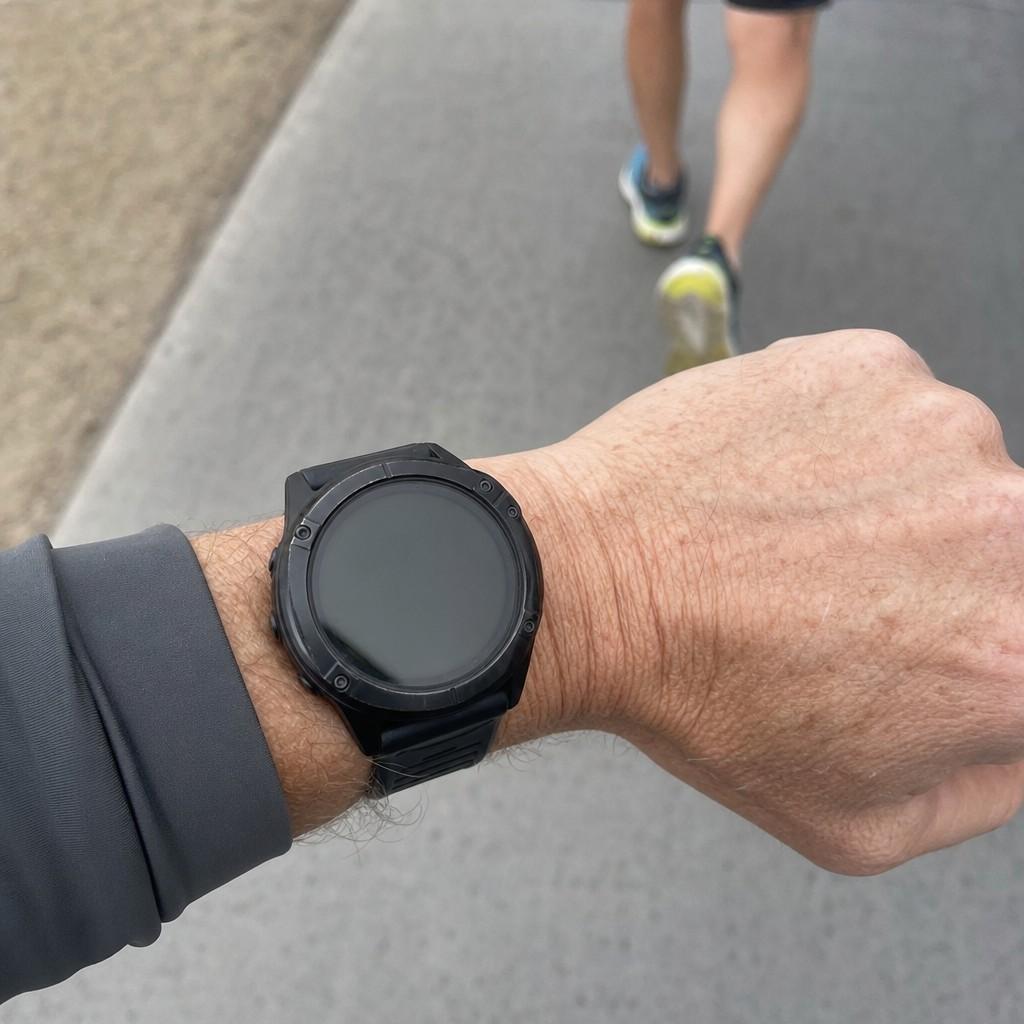
The ratio of running to walking depends on where you are right now. There is no single right answer.
Start conservative and let the body tell you when it is ready for more.
Here is a simple starting framework:
- Week 1-2: Run 1 minute, walk 2 minutes. Repeat 6 to 8 times.
- Week 3-4: Run 2 minutes, walk 2 minutes. Repeat 5 to 7 times.
- Week 5-6: Run 3 minutes, walk 1 minute. Repeat 5 to 6 times.
- Week 7-8: Run 5 minutes, walk 1 minute. Repeat 4 to 5 times.
- Week 9-10: Run 8 minutes, walk 1 minute. Repeat 3 to 4 times.
From there, most runners can move to 10 or 15 minutes of continuous running with a short walk break and keep progressing toward whatever goal they have.
The numbers are a starting point, not a contract.
If week three feels like a grind, repeat week two. The goal is repeatable, not heroic.
The one rule for progressing
Here is how you know you are ready to move up a level: the current week feels almost easy.
Not “I survived.” Almost easy. You finish the last interval and could have done one more.
That feeling of quiet capacity is the green light.
If you are white-knuckling the last few minutes, your body is telling you it needs more time. Give it more time. The week does not expire.
This applies even more after 45 or 50. Recovery takes longer as the years add up. An extra week at the same level is not a setback.
It is training you will absorb and carry forward.
What effort should feel like during the run portions
The running minutes should feel like easy effort, not a sprint. Conversational pace.
You should be able to get a few words out between breaths.
If you are gasping through a one-minute run interval, the pace is too fast. Slow down until the effort feels manageable.
I know the slow pace looks strange from the outside. Run it anyway.
The conditioning builds whether you are moving 12 minutes a mile or 8.
The runner who does three sessions a week for three months comes out well ahead of the one who pushed too hard in week two and spent the rest of the month with a sore shin.
The walk portions are active recovery, not a full stop. Walk at a comfortable pace, let the breathing settle, and move into the next interval.
Walk-run as a long-term tool, not just a ramp
This is the part I want to stay on for a moment.
A lot of runners treat walk-run as a phase to get through on the way to “real” running. Once they can run continuously, they leave the walk breaks behind and never look back.
Some of those runners last a few years before an injury ends the habit.
The runners I see still going at 65 and 70 often use walk breaks.
Not because they have to, but because it keeps mileage consistent and the body fresh. A 30-minute run with four 90-second walk breaks is still 30 minutes of training. The walk breaks do not subtract from it.
They make it possible to string those 30 minutes together three or four times a week, year after year.
There is no rule that says progress means never walking.
Progress means still running next year.
The goal is not to stop taking walk breaks. The goal is to still be running in ten years.
A note on what you might feel
When you start, the running minutes can feel awkward: short, choppy, a little self-conscious out on the road.
Run on a quiet path. No one is watching, and the ones who are have been there.
You will not always feel smooth right away.
The body takes a few sessions to find its rhythm inside the intervals. Give it four or five runs before you judge whether it is working. Most people find the run portions start to feel more natural by the third or fourth session.
This is general training information, not medical advice. If you are working around a joint issue or coming back from an injury, check with your doctor before ramping up the running portions.
The bottom line
Walk-run is not a compromise. It is a method.
It lets people build fitness without breaking down. It keeps runners who would otherwise quit actually running.
Starting conservative and building slowly is not the cautious way. It is the smart way.
Slow the ramp, protect the joints, and you give yourself the best chance of being one of the runners who is still out there, still moving, a decade from now.
Train to run forever. Sometimes that means walking part of it.